
The Prescription · Evidence, not woo-woo
If It's Not (Just) Burnout, Then What?
Burnout is often a culmination, not an event. And sometimes it's something else completely.
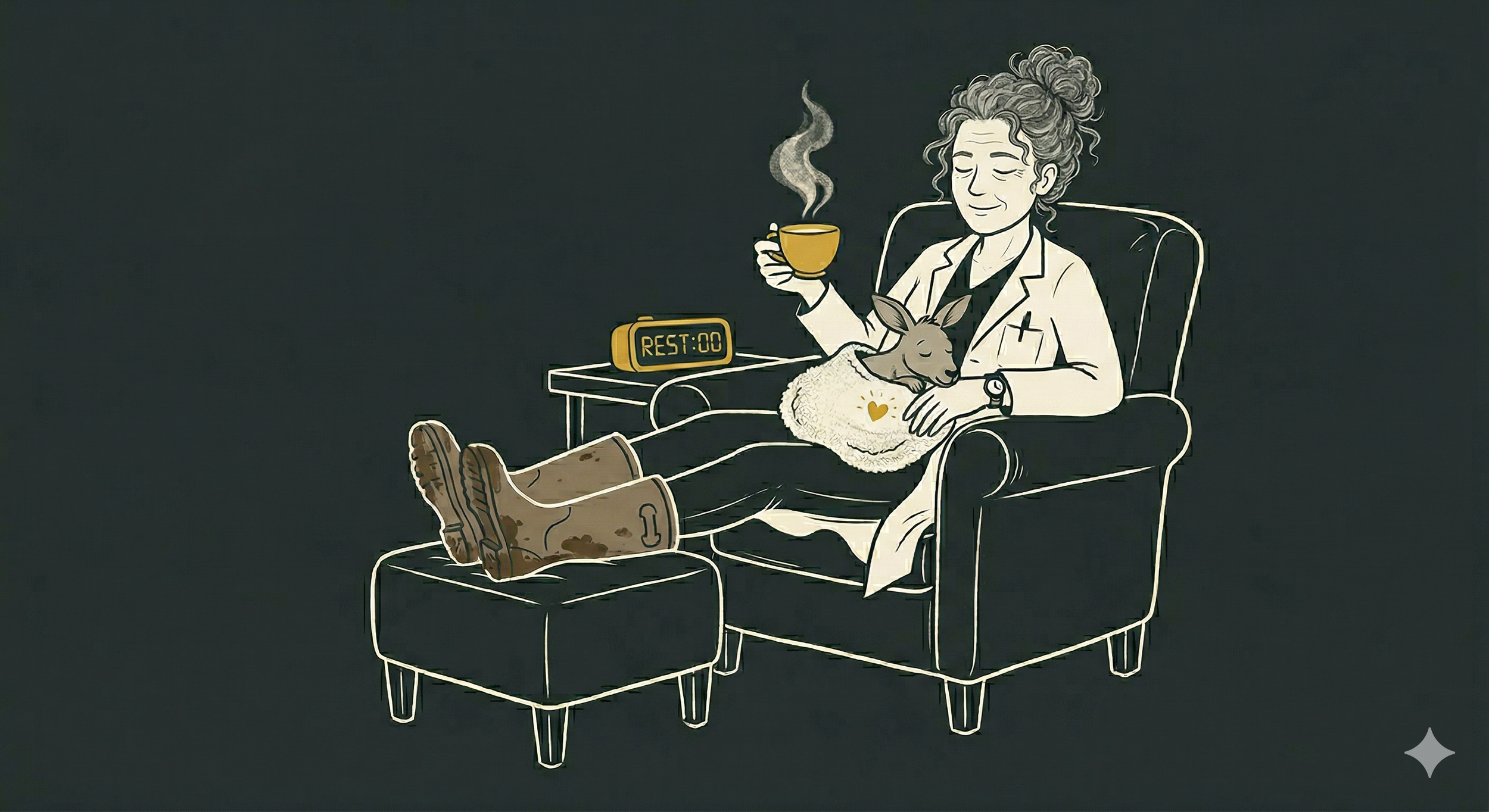
Grab a cuppa, sit yourself down, and give this one a proper read.
"As per usual, I had let it get to an extreme level before it occurred to me that perhaps there was something else at play here."
I'm a physio. I write a publication about the clinical science of burnout. And it still took me six weeks of extreme discomfort after eating before I sat down and did some honest analysis of what was happening.
Which is embarrassing. And instructive. And exactly the point of this piece.
Because burnout is real. It is a brain injury with real biological signatures. Everything I have written about it is true. And sometimes it is also something else.
Any healthcare professional looking at my symptom list on paper, out of context, would say: something is happening in this person's gut. Something is causing malabsorption. Something is affecting their clotting. Something needs to be investigated.
Looking at it inside my own life, I had spent six weeks telling myself: yes but the hormones. Yes but the accountant. Yes but the wildlife shelter. Yes but the tax office. Yes but the PhD.
All of these were true. The first list AND the second list. The problem was using the second list to explain away the first. Which is exactly what burnt-out people do. Which is exactly what I write about people doing.
The answer, in my case, turned out to be a parasite — chronic giardiasis, picked up somewhere between the dam water, the mice, and the many, many buckets of animal poo. But the parasite is not the point. The point is what having a hidden physical driver did to my burnout.
The obvious conflict of interest, up front: we run a 5-day clinical retreat called The Burnout Prescription. The writing has to stand on its own. If the argument is sound, my having a retreat does not make it wrong. Take it or leave it.
The bit that tips you over
The giardia didn't just look like burnout. It ADDED to it.
I was, as usual, juggling and pushing the envelope of what I could get away with. Managing. Not collapsing. Aware I was close to the edge but on top of it, or on top enough. Then the parasite arrived, and what it quietly did was turn up the temperature on a system I was managing at a simmer — like the frog in a pot of boiling water. It added a full new layer of physical stress on top of the psychological load I was already carrying.
The result was that I felt like my burnout was back to a raging inferno. What actually happened is that a physical condition I hadn't identified was making me more vulnerable to full collapse than I should have been.
This is how easily a burnout collapse can happen. Not because the person suddenly can't cope, but because an unexpected physical stressor gets added to the existing load and shifts the whole equation. And these things compound. In my case, the giardia caused iron and vitamin K deficiencies, which then made my perimenopausal bleeding significantly worse, which added yet another layer of physical stress. They are rarely neat, separate lanes. Treating one when there are two in play does not get you back to baseline.
If your burnout has suddenly got dramatically worse — before you assume you have just failed with your coping strategies, ask yourself whether something else has changed. Something physical.
Burnout is real. AND sometimes it is also something else.
Everything I write about the mechanism of burnout — the HPA axis, the neuroinflammation, the flattened cortisol curve, the fact that it is literally a brain injury — all of it is real, and important, and gets ignored by the wellness industry because there is no money in the real answer.
And burnout is a fine line, but it is also a diagnosis of exclusion. Which means: when you have been feeling burnt out for months, and you have done the sleep-and-light protocol and the movement protocol and it is not shifting — you may not just be burnt out. You may be burnt out AND something else. Or you may not be burnt out at all. It may just be something else.
The something else that gets missed is a shorter list than you would expect, and any competent GP can rule most of it out with two blood tests and a conversation. But it requires the conversation to happen. And too many burnt-out people — especially high-functioning women in their forties and fifties — never get the conversation, because 'it's just stress' is the story everyone (including us) reaches for first.
The shortlist. Things that mimic, contribute to, or mask burnout.
- Chronic infection. Parasites (yay). Chronic Epstein-Barr virus reactivation. Post-viral syndromes. Low-grade UTIs. Chronic Lyme, in the regions where it exists. All produce fatigue that presents as burnout.
- Nutrient deficiencies. The real ones. Iron. B12. Vitamin D. Folate. Serum magnesium — the actual test, not the story sold by the wellness industry. Most burnt-out people have never had these properly measured.
- Thyroid dysfunction. Especially subclinical hypothyroidism and Hashimoto's. TSH alone is often not enough; ask for free T4 and, if you can get it, free T3.
- Sleep apnea. Chronically underdiagnosed, especially in women. If your partner mentions snoring or breathing pauses, that is a data point that deserves investigating.
- Perimenopause and menopause. The endocrine transition running alongside the years when burnout is most common. Rarely stands alone; almost always compounds with whatever else is happening.
- Long COVID. A real post-viral syndrome that presents as burnout and needs a different intervention.
- Autoimmune conditions. Particularly early Hashimoto's, coeliac disease, rheumatoid arthritis. All present with fatigue plus something else, and the something-else is often dismissed.
- Depression. Different from burnout, sometimes co-occurring. This is where I stop — it is not my scope of practice. If your mood is persistently low, that is a conversation for a GP or psychologist, not a physio.
What to push your GP for
If you have been telling yourself "it's just burnout" for more than three months, and it is not shifting despite the interventions that should shift it, ask your GP for:
- Full blood count with iron studies. Ferritin, not just haemoglobin. Iron deficiency without anaemia is very common and very missed.
- Vitamin B12, folate, vitamin D. Three cheap tests. Any one of them abnormal explains a lot.
- A full thyroid panel. TSH, free T4, and free T3 if they will run it. Antibodies too, if there is a family history.
- Coeliac screen if there are any gut symptoms.
- Stool testing if there are gut symptoms plus environmental exposure, travel history, or otherwise good reason.
- A conversation about sleep apnea if you snore, if your partner mentions breathing pauses, or if you are still waking unrested despite doing the sleep protocol properly for two weeks.
If your GP dismisses this as 'just stress' without investigating, you deserve a different GP. Or, if you are in Australia, a direct-access pathology request through one of the online services that will let you order these tests yourself. Some symptoms are worth pushing on. You know your body better than anyone in the room.
Scope-of-practice, for the avoidance of doubt.
I am not your doctor. I am a physio who missed her own giardia for at least six weeks by explaining it away with stress, the tax office, and perimenopause. This is the conversation you deserve to have with a GP who takes you seriously. That is the entire scope of my advice here.
You deserve to be investigated.
Burnout is real. Everything in this publication about it stands.
AND — you deserve to be investigated. If the interventions that should be working are not working, don't just try harder. Look harder.
For six weeks, I told myself it was the tax office and the hormones and the wildlife with a sprinkling of my old friend chronic burnout. And it was — those things were real. It was ALSO a parasite that had been quietly eating my ability to absorb the nutrients I needed to think straight.
Both stories were true. The dangerous one was the story that made me stop looking.
Feeling stuck? Start here.
Recognising that something isn't shifting is the change beginning. Three honest next steps, in order:
• Not sure where you sit? Take our free Burnout Assessment, built from the Copenhagen Burnout Inventory. No email required. Use it as a conversation-starter for your GP, not a diagnosis.
• Want the recovery detail? The free Burnout Recovery Handbook covers the rules I used to stop my own relapses.
• Ready to do the physical recovery properly, in person? That is what the 5-Day Burnout Prescription is for: daily float, red light, sauna and physio-led movement matched to your nervous system, all meals sorted, a blue-light-blocking cabin, two hours from Melbourne.
This is the short version. The full essay — with the giardia story in detail, the mechanism of how a parasite quietly rewrites your energy budget, and the complete reference list — lives on my publication, The Burnout Prescription. If you want the evidence, one thoughtful read every week or two and then step away from the device, read the full piece and subscribe here →
More from the desk: browse The Burnout Library, or start with the plain-English guide to burnout recovery.
Stay sane and sceptical. Or at least not too nutty.
Jill Mentiplay
Key references. Because this pillar has receipts.
Einarsson, E., Ma'ayeh, S., & Svärd, S. G. (2016). An up-date on Giardia and giardiasis. Current Opinion in Microbiology, 34, 47-52.
Halliez, M. C. M., & Buret, A. G. (2013). Extra-intestinal and long-term consequences of Giardia duodenalis infections. World Journal of Gastroenterology, 19(47), 8974-8985.
Vaucher, P., et al. (2012). Effect of iron supplementation on fatigue in nonanemic menstruating women with low ferritin. CMAJ, 184(11), 1247-1254.
Biondi, B., Cappola, A. R., & Cooper, D. S. (2019). Subclinical hypothyroidism: a review. JAMA, 322(2), 153-160.
Bonsignore, M. R., et al. (2019). Sex differences in obstructive sleep apnoea. European Respiratory Review, 28(154), 190030.
Full reference list on the complete essay at The Burnout Prescription. This article is for general education and is not clinical advice.