
Are You Burnt Out
or Just Tired?
Most people who are burnt out don't know it. They've called it "normal" for so long they've stopped noticing. Ten honest questions, built from the same clinical tools used in burnout research, will show you where you actually sit. No email. No diagnosis. No sugar-coating.

What Actually Is Burnout?
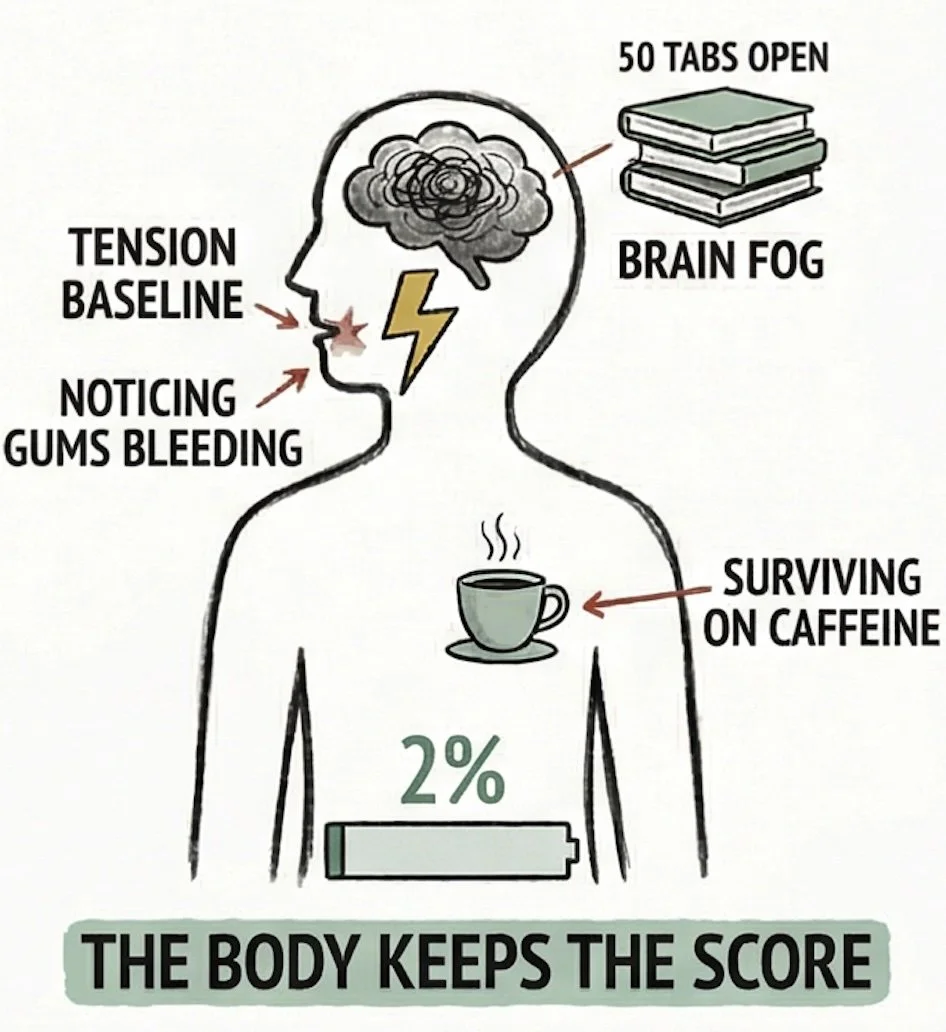
Not a mindset problem. Not a productivity problem. Not something you push through, journal your way out of, or fix with a long weekend. The World Health Organisation classified burnout in 2019 as an occupational phenomenon with its own ICD-11 diagnosis code (QD85). It is a physiological state, not a personal failing.
What makes it so easy to miss is how gradually it builds. Most people adapt to the slow narrowing of their energy and capacity so incrementally that "exhausted and flat" starts to feel like their personality. It isn't. It's a clinical state with three consistent markers, and one of those markers is that you stop being able to see it clearly in yourself. (I know this from both the research and personal experience.)
Exhaustion
Persistent physical and emotional depletion that sleep and weekends no longer resolve. The kind you bring home from the holiday.
Disengagement
Growing distance, numbness, or not-caring toward things you used to care about. Including, sometimes, the business or career you built.
Reduced Efficacy
A sense that nothing you do is quite enough, combined with a growing inability to think clearly, make decisions, or get things done.
Check Your Burnout Level
For each question, choose the response that best reflects how you have been feeling over the past two weeks. There are no right or wrong answers.
If this score doesn't match how you feel
You may not just be burnt out.
If the score reads lower than the way your body feels, or you've been trying to fix "burnout" for months and nothing is shifting — there may be something else running in the background. Chronic infection, low iron, thyroid, perimenopause, sleep apnea. Here's the shortlist and the tests to ask your GP for.
Read: If It's Not (Just) Burnout, Then What? →Built by Someone Who Missed It in Themselves
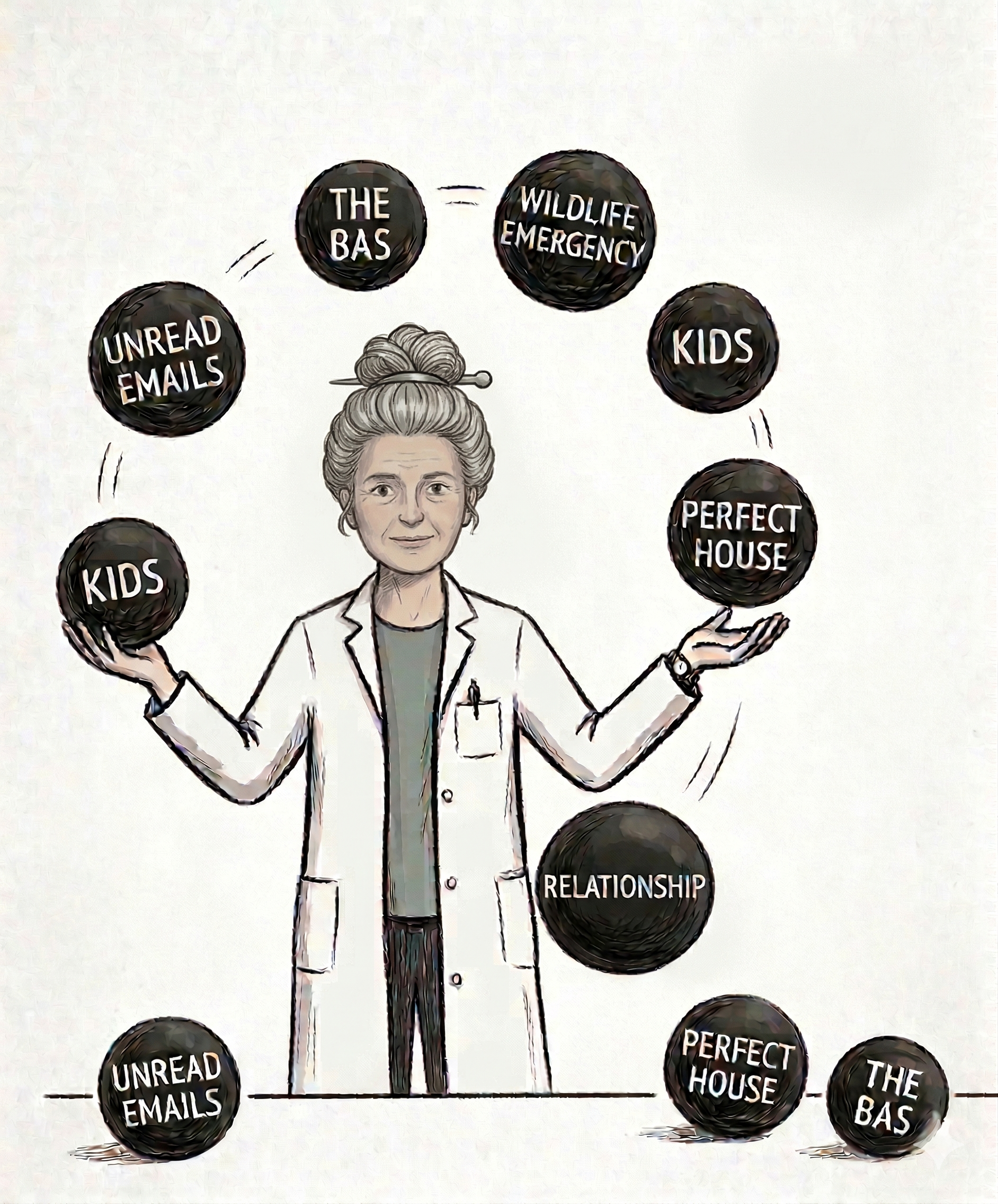
In 2023, I was finishing a thesis, running a working wildlife shelter, raising kids, and managing a business. I was getting up at 3am to find uninterrupted time to write. By the time it became harder and harder to think, harder to feel, and I couldn't get three words on the page, I told myself I was just tired. I thought reaching the finish line would fix it. It didn't. There was no finish line because everything else I'd put off was still there waiting for me.
What I know now, as a physiotherapist who has spent decades working with stressed and depleted bodies, is that my clinical background made it harder to recognise in myself. The fog was too thick and the self-talk too loud. I tried to treat it like an injury. That didn't work either.
I built this tool because I kept meeting people who were deeply burnt out but had normalised it, and because I wished I'd had something like this earlier. It's grounded in real clinical science, it's free, and it doesn't require your email address.
If you want to go deeper on the evidence behind burnout and what actually works for recovery, the Burnout Recovery Handbook is free to download. No email, no sign-up. It covers the physiology, the stages, and the strategies in more detail than a quiz result can.
- AHPRA Registered Physiotherapist (MSc, BPhysio 1st Class Honours, PhD Candidate - University of Melbourne)
- ESSA Accredited Exercise Physiologist (30+ years clinical experience)
- DEECA Licensed Wildlife Shelter Operators
- Airbnb Superhost · Booking.com Award 2024 · Google 5.0
References & Further Reading
Kristensen, T.S., Borritz, M., Villadsen, E., & Christensen, K.B. (2005). The Copenhagen Burnout Inventory: A new tool for the assessment of burnout. Work & Stress, 19(3), 192-207. https://doi.org/10.1080/02678370500297720
Cohen, S., Kamarck, T., & Mermelstein, R. (1983). A global measure of perceived stress. Journal of Health and Social Behavior, 24(4), 385-396. https://doi.org/10.2307/2136404
Schaufeli, W.B., De Witte, H., & Desart, S. (2020). Burnout Assessment Tool (BAT): Development, validity, and reliability. International Journal of Environmental Research and Public Health, 17(24), 9495. https://doi.org/10.3390/ijerph17249495
Maslach, C., & Leiter, M.P. (2016). Understanding the burnout experience: Recent research and its implications for psychiatry. World Psychiatry, 15(2), 103-111. https://doi.org/10.1002/wps.20311
Bianchi, R., Schonfeld, I.S., & Laurent, E. (2021). Is burnout a depressive condition? A 14-sample meta-analytic and bifactor analytic study. Clinical Psychological Science, 9(4), 579-597. https://doi.org/10.1177/2167702620979597
World Health Organisation. (2019). Burn-out an "occupational phenomenon": International Classification of Diseases. ICD-11 Reference Code QD85. who.int
Rotenstein, L.S., et al. (2023). Prevalence of physician burnout during the COVID-19 pandemic: Systematic review and meta-analysis. The American Journal of Medicine, 137(2), 155-164. https://doi.org/10.1016/j.amjmed.2023.09.002
Sonnenschein, M., Mommersteeg, P.M., Houtveen, J.H., Sorbi, M.J., Schaufeli, W.B., & van Doornen, L.J. (2007). Exhaustion and endocrine functioning in clinical burnout. Biological Psychology, 75(2), 176-184.
Black Dog Institute. (2024). Understanding stress and burnout. blackdoginstitute.org.au